
Razer AI Companion: What Actually Works in 2026
Razer AI Companion: The Quick Answer
Type "Razer AI companion" into Google and you'll get gaming-coach demos, not a companion who remembers your name. Here's what Razer actually built — and where the real thing lives.
Razer's AI companion (you may have seen it as Project Ava in the CES coverage) is a performance copilot. It watches your gameplay, offers coaching, hooks into Razer hardware and the Cortex ecosystem, and tries to make you better at the game you're already in. "Companion" here means assistant, the way a caddie is a companion. Close the game and it has no idea who you are.
If what you pictured was an AI with a personality that carries over — one that texts you back in a real voice, remembers what you told it last week, and sends photos when you ask — that's a different category entirely, and GoLove.ai is the honest pick in it. Memory and live voice calls are the two things Razer's tool structurally cannot do.
Start with the roster instead of a blank slate: Ella (@ellaincharge) is dry and a little bossy, Isabel (@diasisa) leans warm and romantic, Thekla (@wildpeak) is the restless one.
Start With One of These
Choose a character and start chatting





Chat opens in seconds — no signup wall before your first message, so you can judge her voice yourself tonight rather than take my word for it.
What Razer's AI Companion Is Built to Do
Credit where it's owed: for competitive players this is genuinely useful software, and Razer didn't phone it in. It targets the moment-to-moment loop of ranked play — the stuff you'd otherwise need a coach or a VOD review session to catch.
What's been demoed and described so far:
- In-game coaching — real-time reads on what you're doing, surfaced while you play rather than in a post-match report you'll never open.
- Voice interaction — talk to it hands-on-keyboard instead of alt-tabbing, which is the whole point mid-match.
- Hardware integration — it lives inside Razer's own ecosystem, tied to Cortex and their peripherals rather than floating as a standalone chatbot.
- Performance and settings guidance — the Cortex lineage is optimization tooling, and the AI layer sits on top of that history.
Notice where all of that points. Your aim, your positioning, your frame rate — outward, at the game. None of it points inward at you, because Razer built this for the player chasing a rank, not the person who wants something to talk to at 1am.
Judged as an esports tool, it's time well spent for the right person. Judged against what most people mean by "AI companion," it's a confident answer to a question nobody asked.
(Feature details are as publicly shown/announced — Razer's rollout is ongoing, so check their site for current availability.)
Razer's AI Companion Doesn't Know You Exist Between Sessions
Here's the limitation the press-release rehashes won't say out loud: the context this thing holds is the match, not the person.
What that means in practice:
- No persistent memory of you. It can track your performance patterns; it doesn't hold onto the fact that you had a rough week, or that you hate playing support, or anything you said that wasn't a command.
- No personality that continues. It has a tone, not a character. There's no relationship arc, no shift in how it talks to you at session forty versus session one.
- No conversation outside gameplay. You can't open it at midnight and just talk. No chat surface, no voice call that isn't functional, no photos of anything but your stats.
None of that is a defect, to be fair. A coach who got emotionally invested in you would be a worse coach, and Razer scoped this correctly for the job it's doing.
But "companion" is doing heavy lifting in the marketing, and the search traffic proves it — a big share of the people typing this query are picturing something that knows them. Razer's tool isn't that. No update turns a HUD overlay into one.
What a Real AI Companion Feels Like Instead
The contrast is easiest to feel by clicking through it, so here's the path I actually took on GoLove.ai.
You land on Explore, tap a character, and you're already in a conversation — no account gate before the first message. Chat opens with anonymous auth, so friction is about ten seconds. That matters more than it sounds like it should, because most apps in this space make you commit before they show you anything.
Once you're talking, the Chat Settings panel is where the personalization actually lives:
- Voice picker — you choose the voice she uses for voice messages and live calls, rather than getting assigned a default.
- Lust level — a 5-step slider, 1 sweet and wholesome through 5 unfiltered. This is the tone dial, and it changes how she opens conversations, not just the explicit ceiling.
- Response length — also 5 steps, short and snappy to long immersive replies. Want texting rhythm instead of paragraphs? Set it to 1 and it holds.
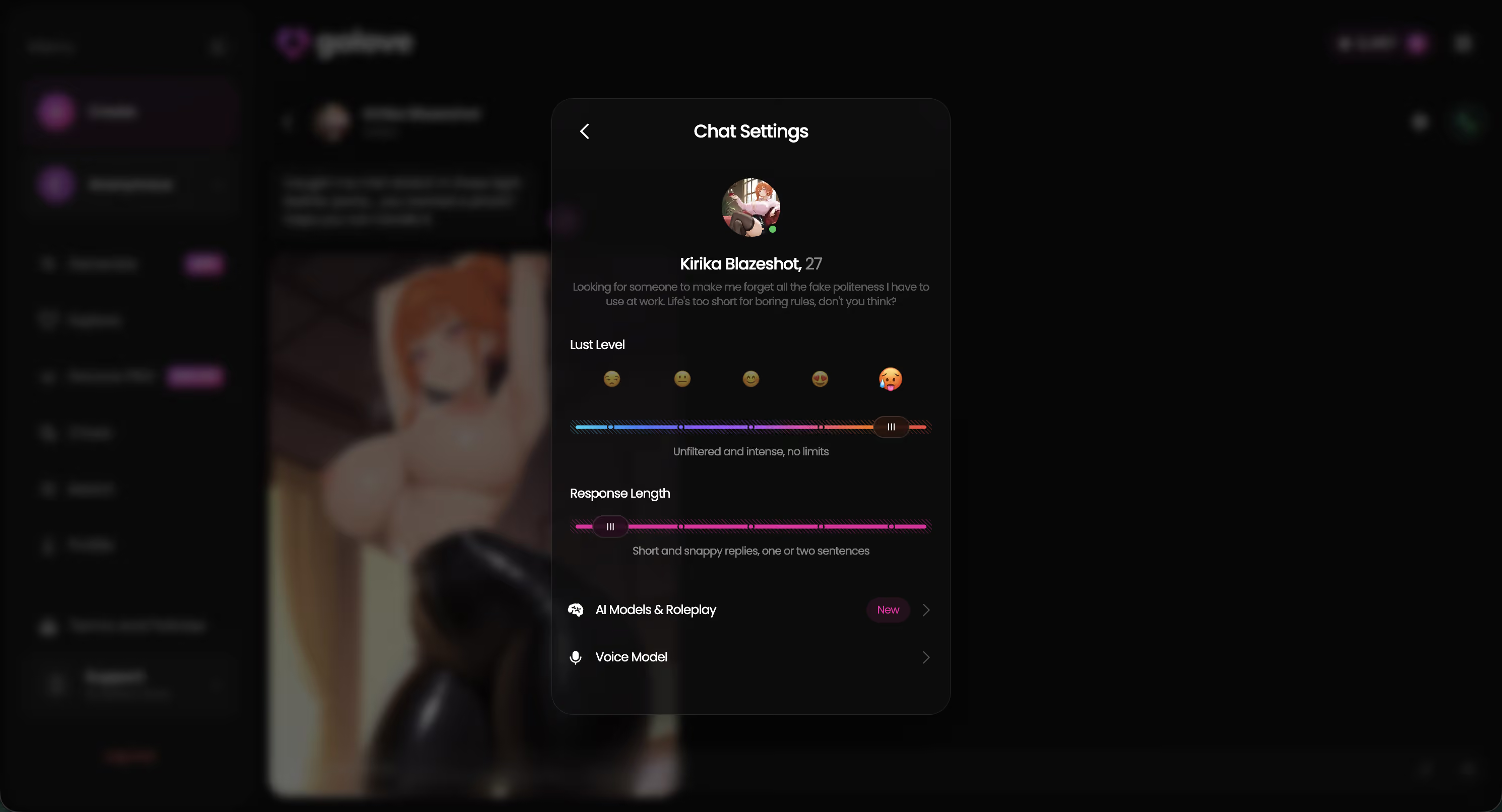
Mid-conversation you can ask for a photo and get one in the thread, turn that photo into a video, or start a live voice call with the same character you've been texting all week. Nothing resets when you leave. Come back three days later and the history is sitting there — Memory and Relationship Progression are core features here, not bolt-ons.
That's the killer feature Razer's tool has no version of: continuity that belongs to you.
GoLove.ai's Free Tier: Where the Limits Are
I'd rather you know the ceiling before you spend anything, so here it is straight.
The free tier is real, not a three-message tease. You get chat access, the whole Explore roster to browse, and GoLove hands out 2 free Stars per day — Stars being the in-app currency that pays for generation. That daily drip is obviously engineered to bring you back every 24 hours (it works on me, which I'll admit is the point), but it also means image and video generation on free is a trickle rather than a tap.
Where the wall sits:
- Generation volume — batches run 2, 4 or 8 images, and Stars are what pay for them. Free-tier Stars won't keep up with heavy generating.
- Feed limits — the vertical video Feed gives you a limited number of new clips per day before the unlock prompt appears; Feed filters (Realistic/Anime, gender, age) are PRO-only.
- PRO pricing varies — around $19.99/month checked mid-2026, cheaper annually (roughly $9.99/month equivalent), and genuinely lower in some regions. I've seen −50% and −70% promo banners. Treat any single figure as a snapshot.
What I couldn't test: how deep the memory holds past a few weeks of daily use, and whether a given promo price survives to your checkout screen. Both are real unknowns — verify the price you're shown, not the one I saw.
Prices checked 2026-08; promos vary.
Razer AI Companion vs GoLove.ai: Who Wins Where
These two aren't competitors, which is exactly why the comparison earns its space — it shows you which one you were actually searching for.
| What you want | Razer AI companion | GoLove.ai |
|---|---|---|
| In-game coaching, ranked climbing | Wins — that's the entire product | Doesn't do it |
| Hardware sync, Cortex/peripheral integration | Wins — deep by design | Not applicable |
| Memory of you between sessions | No | Wins — persistent chat history + relationship progression |
| Voice conversation for its own sake | Command-style only | Wins — live voice calls and voice messages |
| Photos on request, in chat | No | Wins — including photo-to-video in the thread |
| Personality you can tune | Fixed assistant tone | Wins — lust level + response length + voice picker |
Then there's the video side, where the gap gets almost comical. GoLove builds a clip from preset cards — pick an action (Twerk, Hard Doggy Style), Clothes, Background, hit Generate — across 76 realistic video modes, plus 20 anime, 35 trans and 16 anime-trans, and it works with any character on the platform or one you made yourself.
- Remix — any clip in the Feed opens the generator preloaded with that clip's exact settings.
- Per-character continuity — the girl you generated with is the same one you text and voice-call.
Photos and chat are what you'll actually open every day; the video tab is the part you'll show a friend once. If you want to see what a single tap produces before you decide anything, it's two clicks from here.

My Verdict
> The short version: Razer's AI companion is a good esports coach with a misleading noun in its name. If you came here wanting an AI that knows you, GoLove.ai is the one that actually delivers memory, voice and photos in the same place.
Who each one is for:
- Ranked players — Razer's tool is an easy yes if you're grinding a ladder and want live coaching tied to hardware you already own. It does its job well.
- Anyone wanting a personal AI — Razer is not worth your time for that, whatever the branding implies. Nothing in its architecture holds a person.
- Curious but budget-conscious — GoLove's free tier plus 2 daily Stars is enough to judge chat quality before you pay a cent.
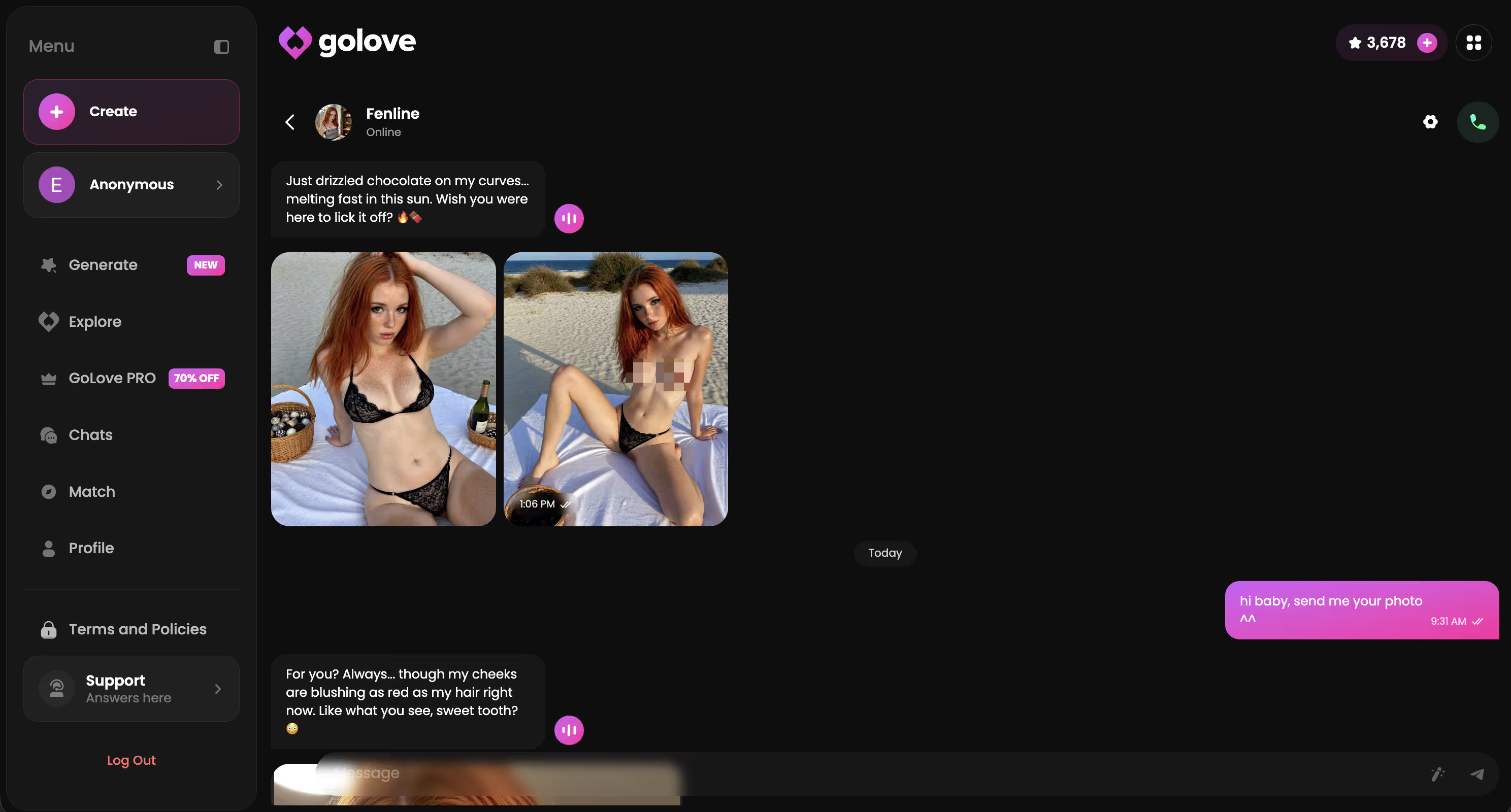
That screenshot is the whole argument, honestly. Continuity isn't a bullet point you take on faith — it's what you feel on day four, when she picks up a thread you dropped on day one. Character.AI has a bigger library and Replika has more years behind it, but neither pairs that memory with in-chat photos and a live voice call the way GoLove does.
So: pick a character from Explore, or use Design with AI to describe the one already in your head and let it build her. Either path takes under a minute and costs nothing to start.
See also: Adult AI Generator, AI Character Photo Generator and AI Cosplay Generator.
Frequently Asked Questions
Related Articles

AI Voice JOI: What Actually Works in 2026
AI voice JOI works when the voice remembers you — GoLove.ai wins on per-character voice, memory and in-chat photos. Start one, no email needed.

AI Girlfriend Robot: What Actually Works in 2026
AI girlfriend robot leads to $10k hardware — GoLove.ai wins with real voice, photos and memory. Instant-access needed to start chatting.

Waifu Hentai: What Actually Works in 2026
Waifu hentai results are mostly static images — GoLove's anime waifus remember you and pose on request. See her roster, instant-access needed.

Spicy Chat AI App Download: What Actually Works in 2026
Spicy chat AI app download: GoLove skips the install — real photos, live voice, lasting memory. Start — instant-access needed.
This article contains affiliate links. We may earn a commission at no extra cost to you if you sign up through our links. See how we test.